
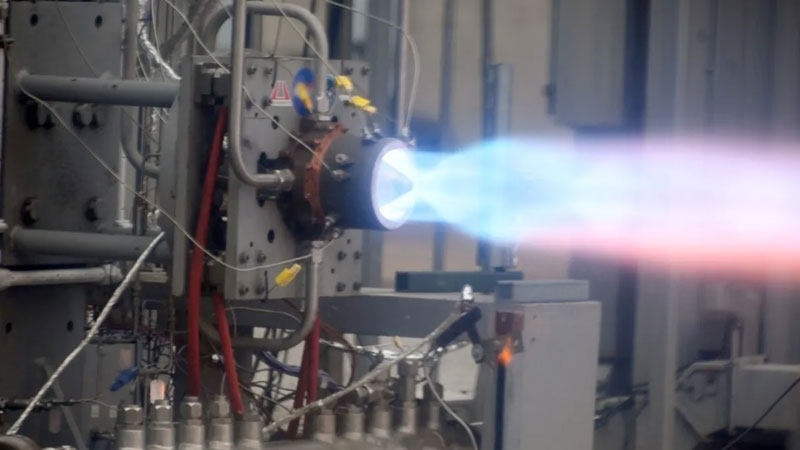
In the United States, protesters demonstrated against the most powerful rocket engine with rotating detonation.
Astrobotic completed testing of the Chakram rocket engine
*A couple of days ago, American company Astrobotic announced the successful completion of a series of tests for its new rotational detonation engine (RDRE) – Chakram.*
What is an RDRE and why it matters – A rotational detonation engine uses a supersonic detonation wave that circulates in a circle inside the combustion chamber.
- It is one of the most advanced approaches in hypersonic rocketry and space vehicles.
- The RDRE promises to significantly increase specific impulse and thrust-to-weight ratio compared with conventional liquid engines.
Tests at Marshall Space Flight Center – The tests were conducted at NASA’s Marshall Space Flight Center site.
- Two prototypes collectively ran for 470 seconds.
- A record was set: continuous burn of 300 seconds, the maximum for this type of engine.
- Thrust exceeded 18 kN, and the company says the design did not sustain any damage.
Management comments
Bryant Avalos (Chief Researcher) – The engine “exceeded expectations,” operating stably without critical deviations. Astrobotic – Thrust levels and burn duration are among the highest in the world for RDREs. Travis Vanzinski (RDRE Program Lead) – Achieving such a result on a modest budget confirms the high skill level of the team.
How Chakram was developed
- The project was carried out jointly with NASA under two contracts: SBIR and Space Act Agreement.
- Additive manufacturing technologies (3D printing) were used to produce components, reducing costs and speeding up the testing cycle.
Application plans
1. Griffin landing module – first flight scheduled for late 2026; the engine could be installed on this module.
2. Reusable suborbital vehicles – Astrobotic plans to adapt the RDRE for a line acquired from bankrupt Masten Space Systems. For this, the company received NASA and U.S. Defense contracts worth $17.5 million.
Engineers are currently working on:
- regenerative cooling,
- thrust regulation,
- reducing engine mass,
to prepare it for flight qualification.
Results
Astrobotic demonstrated significant progress in RDRE technology, becoming one of the leaders in this field.
However, the company remains under pressure after an unsuccessful attempt to build a heavy lunar landing module for NASA; this led to delays in delivering the VIPER lander to the Moon.
 Asted Cloud
Comments (0)
Share your thoughts — please be polite and stay on topic.
Log in to comment