
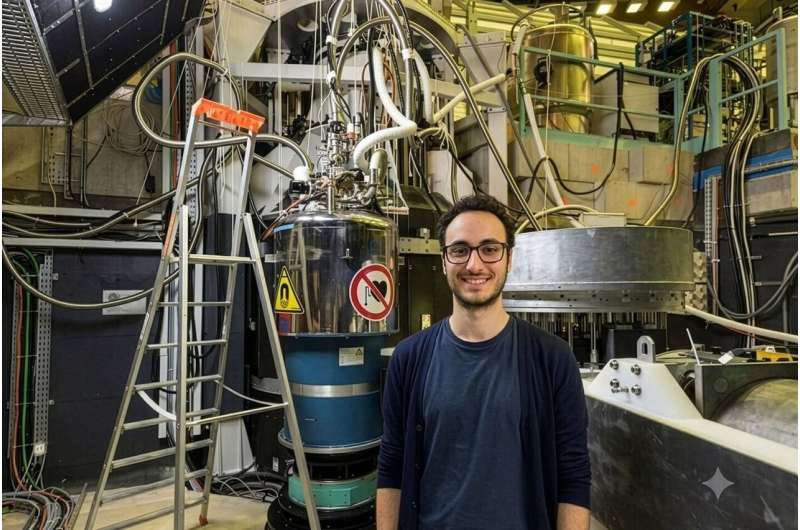
Quantum entanglement was discovered in a centimeter-sized crystal of an unusual metal, as shown by physicists with the "Schrödinger ant farm"
Quantum “entangled” strange metals: a new experimental breakthrough
What are strange metals?
Strange (or non‑Fermi) metals are rare alloys whose properties lie in an intermediate state between dielectrics and ordinary conductors. They have free electrons, but they do not behave like conventional metals: resistance changes almost linearly with temperature, and as the temperature approaches absolute zero, unusual quantum effects appear. At present these materials are poorly studied; even Wikipedia does not have a full article about them.
Why it is important to study their current
In ordinary conductors electric current is carried in “pulses” – collective dynamics of quasiparticles. In strange metals, on the contrary, current flows smoothly, without noticeable fluctuations, like water in a channel. This unusual behavior attracts scientists who try to understand why and how quantum effects can be “felt” at a macroscopic level.
Experiment: from crystal to quantum entanglement
1. Synthesis – researchers from Vienna University of Technology created a centimeter‑sized crystal Ce₃Pd₂₀Si₆ (from cerium, palladium, and silicon).
2. Conditions – the crystal was cooled to tens of millikelvins and placed in a magnetic field of 1.73 T along the [001] axis.
3. Measurements – used inelastic neutron scattering at the Institut Laue‑Langevin (ILL) in France.
What was discovered
- When irradiated with neutrons, the system responded much more strongly than expected.
- Instead of releasing energy to a single particle, the material showed a collective response – a “group” interaction.
- Analysis using the Fisher parameter (a quantum metrological indicator) showed that at least nine quantum‑entangled objects act together.
Thus, the Ce₃Pd₂₀Si₆ crystal demonstrates group quantum entanglement even in a centimeter‑sized volume. This is the first case where such an effect has been recorded in a “large” piece of material.
What it means
- The experiment links solid‑state physics with quantum mechanics: observable properties can now be described using the language of quantum information.
- It helps explain why current flows smoothly in strange metals (the disappearance of quasiparticles) and why resistance depends linearly on temperature.
- According to scientists, “from Schrödinger’s cat” one can move to a “Schrödinger’s ant colony”: one excited element triggers a reaction in nine entangled neighbors.
Conclusion
The new experiment opens the way to understanding and using quantum effects in macroscopic systems. Strange metals, thanks to their unique structure, become living examples of how collective quantum entanglement can manifest itself in real materials.
 Asted Cloud
Comments (0)
Share your thoughts — please be polite and stay on topic.
Log in to comment