
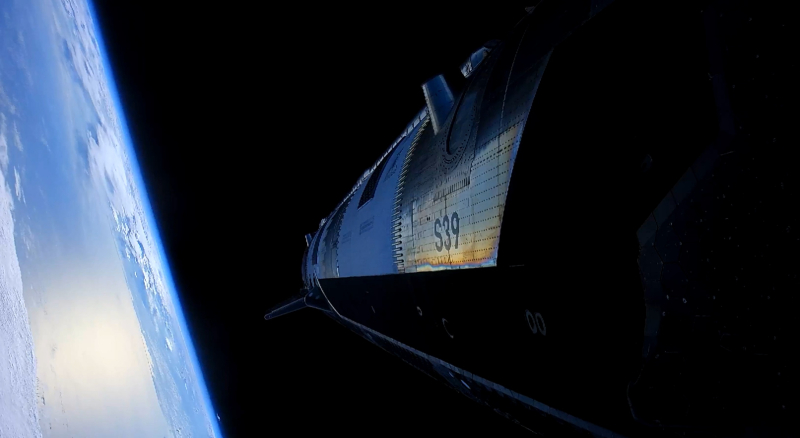
SpaceX launched its new megarocket Starship V3 into space for the first time—after losing an engine, the mission still ended successfully
Date and launch location
On May 23 at 01:30 Moscow time (May 22 at 18:00 local time) SpaceX carried out another test launch of the super-heavy Starship rocket complex from the Starbase site in Texas. This was the first flight of the new Starship V3 version and the Super‑Heavy V3 booster.
Mission progress
The rocket launched on schedule, successfully completed ascent and hot stage separation. After separating from the booster, Starship continued its flight along the planned trajectory despite one engine shutting down. By the 20th minute of the mission, the ship began deploying Starlink satellite mock‑ups – quad‑rotor units that unfolded into space.
Launch specifics
- This was the first megarocket launch from the new Starbase Pad 2.
- A key objective was to test the new Super‑Heavy V3 + Starship V3 combination.
The linking node is now integrated into the booster, reducing its mass and lowering rocket production costs.
- For safety, the booster was deliberately dropped into the waters of the Gulf of Mexico – the design incorporated many changes that had not yet passed flight testing. The booster did not burn all its fuel (likely due to a partial engine failure) and safely fell into the Atlantic Ocean several minutes after launch. The cause of the failure is still unknown.
Flight path
Starship V3 performed a series of orbital operations, including deploying satellite mock‑ups. The flight will end with a landing in the Indian Ocean off the coast of Western Australia approximately 65 minutes after launch. During descent, new heat‑shield tiles will be tested.
Technical specifications
- Diameter: 9 m
- Height: ~124 m
- Payload capacity: about 100 t to low Earth orbit
Unlike Falcon 9, which remains partially reusable, Starship is being developed as a fully reusable rocket with both stages returning. This should significantly lower the cost of payload delivery and enable launches of heavier next‑generation Starlink satellites, large orbital platforms, and even interplanetary craft.
Context
The launch occurred amid heightened attention to SpaceX, which is preparing for its first public share offering (IPO) – the largest in history. A successful 12th test flight of Starship strengthened the company’s position and Elon Musk’s leadership, and laid the groundwork for further project development: expanding the Starlink satellite network, orbital data centers, artificial intelligence, and space expansion within the Solar System.
 Asted Cloud
Comments (0)
Share your thoughts — please be polite and stay on topic.
Log in to comment