
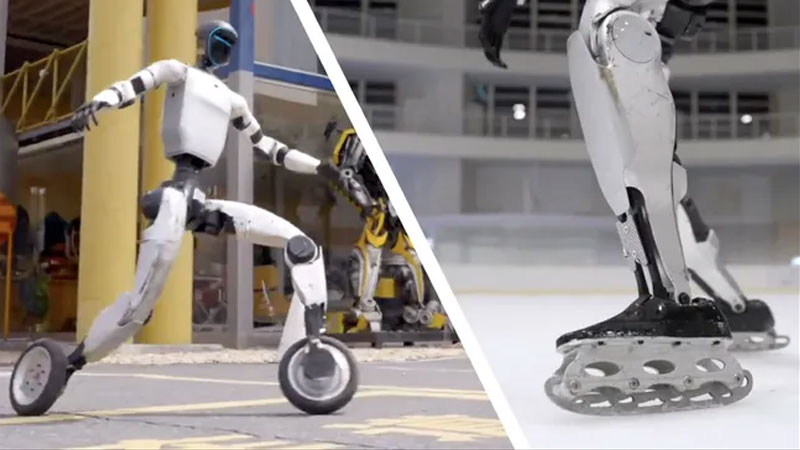
AI forced humanoid robots to skate, and we didn’t anticipate such a style of hockey.
Robot Unitree G1: from wheels to skates
The first attempts at robots playing football still look quite clumsy. In hockey it’s even more complicated – sliding adds unpredictability and requires special reactions. It is especially surprising to watch the humanoid robot Unitree G1, which moves freely across the field first on wheels, then on rollers, and finally on ice skates. There is very little time left before the winter Olympic games for robots, and the upcoming competitions promise to be exciting.
How Robots Are Trained
The development of generative neural networks has greatly accelerated robot training in movements, gestures, and body control.
* Most of the training takes place on a computer: behavior models are created.
* On the actual robot a *fine‑tuning* is performed: the reactions of electronics and actuators are checked.
These mechanisms often surpass human capabilities. When walking on two legs, which robots have been trained for ten years, the difference is not so noticeable, although they can run faster than people. Adding wheels gives them agility: just as in antiquity the wheel accelerated civilization’s development, it also improves robot mobility.
What Is Unitree G1
* Size – height about 1.2 m, weight 35 kg.
* Cost – roughly $16,000.
At first glance it may seem extravagant to train such a compact robot for figure skating or hockey. However, there is a deeper meaning: humanoid platforms are still being mastered and searching for their place alongside developers. Their application, capabilities, and benefits for people are still being studied.
Why This Is Important
“Fetch‑and‑deliver” tasks are primitive and not worth investing heavily in. Only by testing robots in various conditions can we make the right choice. This applies to both humans and machines: they can become better than humans in their specialization. Therefore the question arises: do we need such hockey? The answer may surprise you and prompt reflection on the future interaction between human and machine.
 Asted Cloud
Comments (0)
Share your thoughts — please be polite and stay on topic.
Log in to comment