
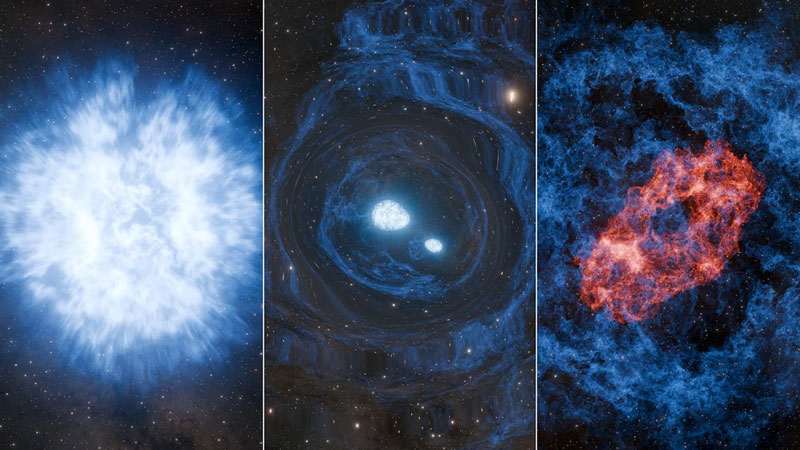
Astronomers first recorded a mysterious supernova explosion that required the development of a new theory.
New type of cosmic explosion: “superkilonova”
ItemWhat happenedAfter detectionIn August 2025 gravitational‑wave detectors LIGO and Virgo recorded event AT2025ulz at a distance of 1.3 billion light‑years. First signalA gravitational pulse appeared, characteristic of the merger of low‑mass objects – like neutron stars. This reminded of GW170817 (2017) and became the second registered case of a kilonova birth. Coordinate determinationThe positional accuracy obtained by gravitational methods leaves much to be desired, complicating the search for an optical counterpart.
How the event unfolded
1. Classic start of a kilonova
- Telescopes around the world (including Palomar Observatory) observed a rapidly fading red glow typical of heavy‑element synthesis (gold, uranium).
2. Unexpected change
- A few days later the flare intensified, took on a blue tint and hydrogen appeared in the spectrum – signs of an ordinary supernova. This confused observers.
3. Localization problems
- Because the probability of two powerful catastrophes occurring simultaneously in one patch of sky is extremely low, scientists assumed it was a single, but unusual event.
Theoretical model
- Supernova collapse:
During the collapse of a rapidly rotating massive star fragmentation could have occurred, producing two super‑light “forbidden” neutron stars (mass < 1 M☉ – contradicting existing theories).
- Merger and kilonova:
These newly formed objects, spiraling around each other, collided almost instantaneously, triggering a kilonova and a gravitational signal.
- Persistent shock wave:
The shock wave from the initial supernova explosion continued to expand outward, creating a second optical trace – a typical supernova.
Thus a “cosmic matryoshka” was observed: two markedly different signals (kilonova and supernova) sequentially appeared in one event.
What next?
- New data needed
To confirm or refute the existence of such “superkilonovas,” further observations are required.
- Rubin and Roman observatories:
- *Rubin* already monitors fast‑evolving events.
- *Roman* is planned to launch into space in September 2026.
Good luck to both teams!
 Asted Cloud
Comments (0)
Share your thoughts — please be polite and stay on topic.
Log in to comment