
Chinese scientists have developed an air–steel flow battery capable of operating for 16 years without loss of efficiency
New type of air‑iron flow battery from Chinese scientists
*The Chinese Academy of Sciences (CAS) has introduced a completely new design for a flow battery system capable of withstanding over 6,000 charge–discharge cycles without significant capacity loss.*
What makes this battery special
Feature Description
Electrolyte Water – completely eliminates the fire and explosion risk inherent to lithium‑ion batteries.
Cost The absence of lithium makes the device “effectively inexpensive.”
Cyclic stability Over 6,000 cycles at a current density of 80 mA/cm² with Coulombic efficiency of 99.4 %. This is equivalent to ~16 years of daily operation.
Power At higher loads, peak power density reaches 392.1 mW/cm² while overall energy efficiency remains at 78.5 %.
How the degradation problem was solved
The key obstacle for air‑iron flow batteries has been low reversibility of reactions and unwanted transport of active species across the membrane.
Scientists:
1. Reviewed electrolyte composition, testing 12 different organic ligands.
2. Created 11 new iron complexes.
3. Identified the most stable one – the complex [Fe(HPF)BHS]⁴⁻.
This compound possesses:
- A protective molecular structure that shields the iron center;
- Negatively charged groups that repel hydroxide ions and reduce their penetration through the membrane.
How the flow battery works
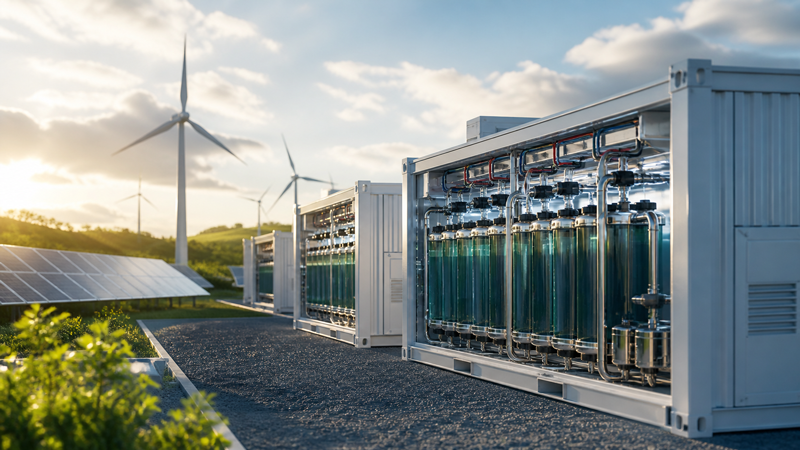
*Liquid electrolytes are stored in external tanks and circulate through an electrochemical cell.*
The advantage of this scheme is simple scalability: by increasing tank volume, energy capacity can be increased linearly. This makes the technology especially attractive for storing energy from solar and wind power plants.
What remains to be done
- At present there are no announced experimental projects or plans for industrial production.
- Successful laboratory results do not always guarantee reproducibility at larger scales.
Nevertheless, if the process can be scaled up, cheap iron could become a serious competitor in long‑term renewable energy storage.
 Asted Cloud
Comments (0)
Share your thoughts — please be polite and stay on topic.
Log in to comment