
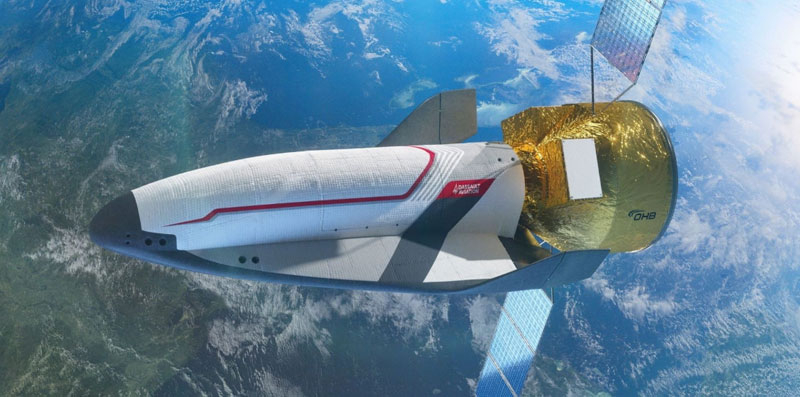
Europe is once again striving for its own “shuttle”: German support for the VORTEX project, a space plan from France, has been confirmed
Europe Returns to Space: New European Spaceplane VORTEX‑S
*The space race is no longer in Europe’s favor, but European companies continue to fight for the restoration of their positions. A key element of the strategy becomes the development of reusable spaceplanes – small shuttles that can be launched on rockets and return to Earth.*
1. What’s new?
French Dassault Aviation announced a spaceplane project a year ago. Recently German company OHB SE joined it, and negotiations are underway with other European partners. As a result, the project becomes “pan‑European” and receives the name VORTEX‑S.
- Dassault Aviation is responsible for the design and manufacturing of the spaceplane itself.
- OHB SE develops a service module that connects the shuttle to the launch vehicle and adds additional functions (e.g., autonomous satellite servicing).
2. Technical specifications
Parameter VORTEX‑S VORTEX‑C (transport) VORTEX‑H (piloted)
Length ~8 m 12 m 12 m
Wing span ~7 m 7 m 7 m
- The wings do not fold, so the spaceplane is launched without a fairing.
- The dimensions make VORTEX‑S about one third smaller than its “siblings”.
3. Capabilities and missions
VORTEX‑S is positioned as a multi‑purpose next‑generation orbital platform:
1. Transport of cargo to orbital stations.
2. Autonomous flights in free mode.
3. Inspection of satellites and “intervention operations” in orbit.
4. Capability to perform military tasks (according to Dassault).
5. After mission completion – soft return to Earth with acceleration up to 2 g, allowing safe delivery of fragile payloads.
The VORTEX architecture is closer to American spaceplanes Boeing X‑37B and Dream Chaser than to the classic Space Shuttle. This makes it more flexible and suitable for various tasks.
4. Development plan
1. VORTEX‑D demonstrator
- Experimental vehicle at 1:3 scale.
- Test of aerodynamics, thermal insulation, and orbital maneuvers.
- In April 2026 Dassault selected Spanish company Arkadia Space to build the demonstrator’s propulsion system (low thrust for orbit correction).
2. Full‑scale VORTEX‑S
- Planned for launch in the 2030s as a regular platform.
3. Cargo and piloted versions
- Expected after mid‑2030s.
5. Why this matters to the EU
- Restoration of experience lost after the Hermes program was shut down.
- Reduction of dependence on American space systems (NASA, SpaceX, etc.).
- Creation of own reusable orbital aircraft capable of both scientific and military missions.
Conclusion: VORTEX‑S is Europe’s step toward independence in space. If the demonstrator successfully flies in 2028, a few years later Europe will be able to regularly launch its own reusable shuttles, returning cargo and people to Earth without large costs.
 Asted Cloud
Comments (0)
Share your thoughts — please be polite and stay on topic.
Log in to comment