
Kioxia found a way to bypass competitors by avoiding the increase in NAND layers
Cyprus 3D‑NAND memory: how Kioxia is trying to catch up with the leaders
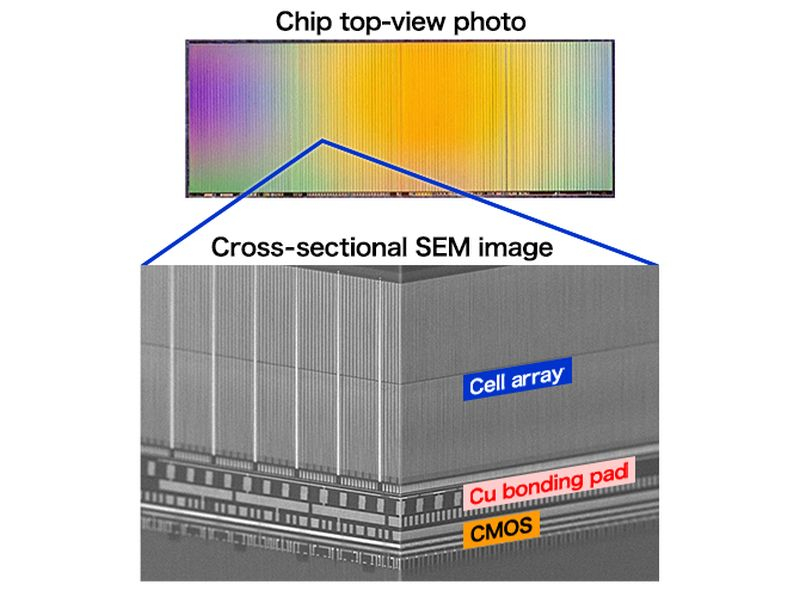
*The multilayer memory technology first proposed by Toshiba in 2007 still does not give the Japanese manufacturer a competitive advantage. To compensate for the lag in layer count, the company is developing its own silicon wafer bonding technology – CBA (Chip‑Bonded Array).*
What CBA is and why it’s needed
- Traditional approach
In classic NAND chips, the control logic was placed on the same substrate as the memory cells. This limited density: the more layers, the higher cost and complexity of production.
- Kioxia’s new idea
With CBA, the control wafer is separated from the cell wafer and then connected to it at the level of microscopic contacts. This allows “gluing” several memory layers onto one managed board without increasing the number of layers on a single substrate.
- Advantages
- Increased capacity without raising layer count.
- More flexible chip architecture.
- Reduced cost for high‑density production.
Current market figures
Parameter | Kioxia (3D‑NAND) | Competitors
---|---|---
Number of layers | ~218 | >300, aiming for 400
Read/write speed | +20–30 % compared to analogues |
Kioxia already uses CBA in its “flagship” products. Nevertheless the company remains third in the solid‑state memory segment, trailing South Korean giants (Samsung, SK Hynix). Kioxia’s positions in the profitable and fast‑growing server market are still weak.
What this means for the future
- Growth potential
If CBA technology truly enables higher density without significant cost escalation, Kioxia could shift the balance of power in the NAND memory market.
- Key factor – connection precision
For mass production, high positioning accuracy of wafers is critical. Analysts say that’s where Kioxia outpaces competitors.
Conclusion
Kioxia continues to fight its layer‑count deficit by adopting the innovative CBA technology, which promises to increase capacity and speed of NAND chips. While results have not yet completely overturned the market, new solutions could become a decisive factor in the battle for leadership in the solid‑state memory segment.
 Asted Cloud
Comments (0)
Share your thoughts — please be polite and stay on topic.
Log in to comment