
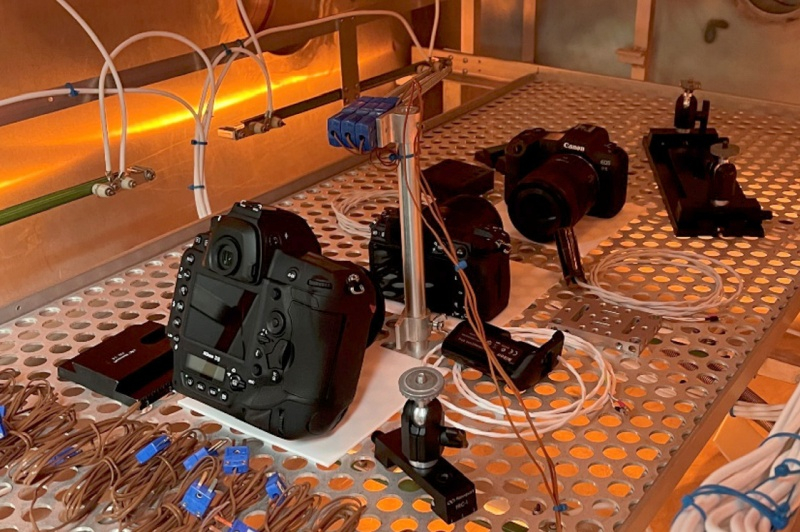
NASA tested standard Canon and Nikon cameras in space conditions—only a few of them passed the test
NASA checks camera readiness for space conditions
NASA always carefully selects equipment that must operate in the harsh conditions of space. Recently, the agency published results from the first tests of portable cameras conducted in 2022. The report compares standard models Canon EOS R5, Nikon D6 and Nikon Z7II, which were subjected to tests as close as possible to real space conditions.
Camera Results Vacuum Test Temperature Range Features
Canon R5 Successfully passed –30 °C … +40 °C Operated in Wi‑Fi/Bluetooth mode; video recorded until overheating, after which a 5‑minute rest was given.
Nikon D6 Successfully passed –30 °C … +40 °C RAW and JPEG shooting (settings succeeded), but video tests were not conducted due to risk of connection loss.
Nikon Z7II Not fully passed Operated at room temperature, but at extreme temperatures it lost contact after recording video and did not recover. The camera remained operational but was deemed unreliable for space tasks.
How the tests were carried out
1. Preparation – cameras and accompanying equipment were heated to 50 °C for 72 h to eliminate volatile substances.
2. Tests – the cameras were placed in a temperature‑controlled enclosure inside a vacuum chamber. Photo/video control was performed via Wi‑Fi and Bluetooth.
3. Photography – both cameras operated in photo mode as well as video (with limitations for D6).
Radiation testing results
The report also evaluated four CFexpress cards: Lexar, SanDisk, ProGrade and Sony. None of the cards failed completely; temporary errors caused by radiation were resolved by rebooting the card. The most reliable was the SanDisk card, but authors emphasize that the choice depends on specific test conditions and radiation level.
Connection to subsequent projects
The 2022 report is especially important in the context of later NASA studies on creating a specialized lunar camera. In 2024 the agency published results from testing a modified commercial camera for the lunar environment. It was noted that the thermal protection system and camera continued to work under many simulated conditions, but issues arose with image duplication on the LCD screen and overheating at extreme temperatures.
Current portable NASA campaign
Today, NASA’s universal lunar camera is based on a modified Nikon Z9. It incorporates Nikkor lenses, a protective heat blanket and a special handle that allows an operator to work in space suit gloves.
Thus, NASA confirms that the Canon R5 and Nikon D6 can withstand space tests, while the Nikon Z7II is not yet ready for the full spectrum of conditions. The CFexpress card radiation test results provide additional information on the reliability of wearable devices under increased radiation.
 Asted Cloud
Comments (0)
Share your thoughts — please be polite and stay on topic.
Log in to comment