
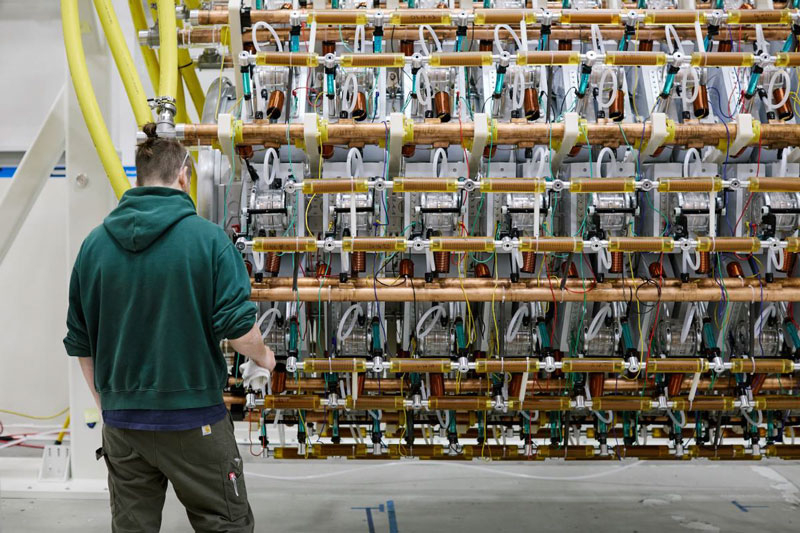
Pacific Fusion conducted tests of a prototype budget nuclear fusion device that uses capacitor-driven fuel compression for inertial ignition.
Pacific Fusion Demonstrates a New Approach to Thermonuclear Compression
American startup Pacific Fusion announced the results of testing a reduced prototype of an impulse energy module designed for a future thermonuclear plant. The device, about the size of a standard shipping container, delivered roughly 440 GW peak power over 80 ns at a voltage of approximately 1.1 MV. A key feature of the experiment was the use of a bank of capacitors to initiate the reaction instead of expensive lasers.
How the Technology Works
Pacific Fusion employs the principle of *inertial confinement* of fuel: an ultra‑strong electromagnetic field is generated around a miniature fuel pellet, causing a sharp rise in pressure and temperature. As a result, light nuclei inside the capsule fuse into heavier ones, releasing enormous energy. This could be a clean source of power with virtually limitless fuel supplies.
Today, the only project that has shown a net positive energy output from inertial confinement is the National Ignition Facility (NIF) – an American complex of nearly 200 powerful lasers focused on a tiny fuel capsule. However, given all the energy required to operate the complex, its efficiency is only in the tens or hundreds of thousandths of a percent, and the cost remains too high for commercial use.
Pacific Fusion’s Capacitor Approach
The company’s core idea is to compress fuel using synchronous activation of powerful capacitors. If 100 ns are triggered with a mismatch of no more than 2 ns, the discharge creates the necessary field and initiates the thermonuclear reaction. The reduced demonstrator successfully executed this scheme, but without actual fuel.
According to the startup, the experiment was so successful that it attracted over $1 billion in investment for further development of the technology.
Future Plans
In the summer, Pacific Fusion plans to begin construction of a full‑scale demonstrator. A site has already been selected. The new facility should show the ability to launch capacitor banks synchronously, which, with fuel present, could initiate a reaction with net positive energy output – i.e., produce more energy than is spent on ignition.
Although building a commercial thermonuclear power plant on this principle may take decades, confirming the viability of the approach itself now would already require substantial funds.
 Asted Cloud
Comments (0)
Share your thoughts — please be polite and stay on topic.
Log in to comment