
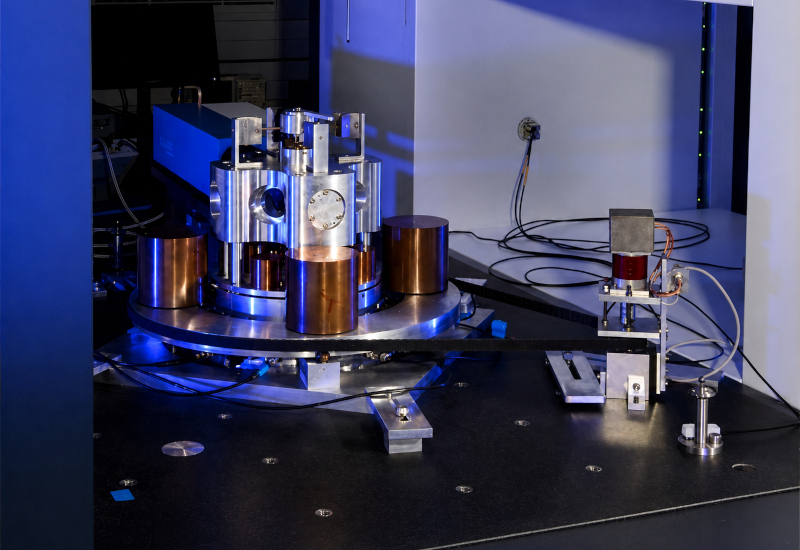
Physicists have been trying to measure the gravitational constant for ten years—and again failed to arrive at a single value of the “big G.”
New measurement of the gravitational constant from NIST
*Physicists from the National Institute of Standards and Technology (NIST) in the United States have completed a decade-long experiment measuring the gravitational constant G. The obtained value differs both from the previous French result and from the international reference value, yet an previously unaccounted-for phenomenon has been identified that could explain the discrepancies between different measurements.*
What is “big G”?
The gravitational constant G describes the force of attraction between two masses. It is one of the fundamental constants of physics, but its exact value has remained a subject of debate for more than 200 years. Gravity is the weakest of the four fundamental interactions, so measuring it with high precision in a laboratory is extremely difficult.
Today there are 16 experimental values of G obtained by different groups of scientists. As NIST physicist Stephan Schlamminger noted in *Refractor*, “the data are highly scattered, and the uncertainty is about 10⁻⁶ parts.”
Why was the French experiment chosen?
Instead of conducting a new measurement, Schlamminger’s team decided to reproduce the 2014 experiment carried out at the International Bureau of Weights and Measures (BIPM) in France. That experiment yielded one of the most divergent values of G, so repeating it could uncover hidden systematic errors.
* The apparatus was transported across the Atlantic to NIST’s laboratory in Gaithersburg, Maryland.
* Work began in 2016 and continued for ten years.
Result
The obtained value:
\[
G = (6.67387 \pm 0.00038) \times 10^{-11}\; \text{m}^3\,\text{kg}^{-1}\,\text{s}^{-2}
\]
This number is 0.0235 % lower than the original French result. In the context of other fundamental constants measured to dozens of decimal places, such a discrepancy remains significant.
Revealed source of error
The main discovery is the residual air effect. While operating the apparatus, the chamber is pumped down, creating a vacuum, but it is impossible to remove all air completely. “There is always a small amount of air left – this is called residual pressure,” explains Schlamminger. This remaining gaseous environment exerts a weak force on the system that previous experiments did not account for.
This factor could be key to understanding the reasons behind the inconsistent G measurements worldwide.
What next?
Schlamminger is not yet ready to apply this finding to all other experiments. “Each experiment must be examined separately to understand what was actually done,” he says. The new value is slightly lower than the recommended CODATA (2018), but the exact cause of the discrepancy cannot yet be determined.
“Until we believe it may be related to a range of effects, but exactly which ones influence the results has not been clarified,” the scientist summed up.
 Asted Cloud
Comments (0)
Share your thoughts — please be polite and stay on topic.
Log in to comment