
Physicists have developed a brand‑new camera to detect neutrinos and dark matter
New way of registering elementary particles: from bulky detectors to a single camera
An international group of scientists led by Swiss physicists has presented a revolutionary method for detecting neutrinos and dark matter. Instead of the usual massive systems divided into thousands of segments, they used a single light‑field camera combined with a highly sensitive photon detector. This approach makes the detector simple and economical, which could accelerate the search for the most elusive particles.
Traditional neutrino detectors
Modern setups for registering traces of neutrino decay are huge volumes of ultra‑pure liquid permeated with photodetectors (photomultipliers). Neutrinos do not interact directly with matter because they lack charge and have a small mass, so their “traces” are visible only after atoms in the liquid decay. Such detectors can be artificial (for example, in large tanks) or natural – as in Baikal, Antarctica, or on the bottom of the Mediterranean Sea. In both cases the volume is divided into sectors, which leads to the use of tens of thousands of sensors.
Compact solutions and their limitations
For laboratory experiments one can use more compact detectors, but they still retain a sector structure and an optical‑fiber network of tens of thousands of channels. This density allows recording subatomic particle trajectories with accuracy down to hundredths of a millimeter in a short time. A neutrino collides with an atom, breaking it into smaller particles; the tracks of these fragments reconstruct the “culprit” event.
New PLATON technology
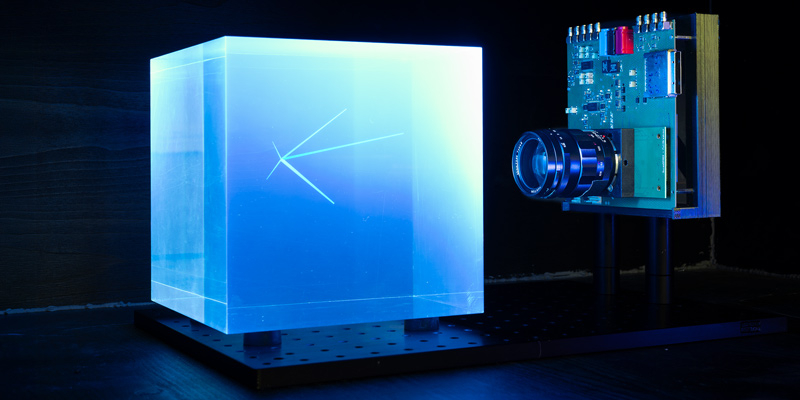
Scientists from ETH Zurich and EPFL developed the PLATON sensor, which does not require segmentation of scintillating material. Inside a single volume decay traces of neutrinos are created and then recorded by photons. One camera replaces thousands of sensors, preserving and even improving resolution.
The PLATON camera uses a microlens array that records not only light intensity but also its direction. This allows reconstructing the three‑dimensional trajectory of a particle without physical detector segmentation. Tests with a strontium‑90 source (electrons) confirmed the method’s effectiveness.
Resolution and scaling
Modeling shows that for a scintillator sized 10 × 10 × 10 cm the system achieves track resolution below 1 mm. When scaled up to one cubic meter (the standard size of neutrino experiments) the accuracy remains within a few millimeters – comparable to the best world analogs, but with significantly lower assembly complexity.
A Transformer‑based neural network plays a key role in image processing, efficiently extracting useful signals from the “noise” of scintillating photons.
Prospects for application
The developers have already filed three patents for using PLATON technology in positron emission tomography (PET). The team expects that further design improvements will allow achieving sub‑millimetre resolution for detectors larger than one cubic meter – opening new possibilities both in dark matter searches and medical applications.
 Asted Cloud
Comments (0)
Share your thoughts — please be polite and stay on topic.
Log in to comment