
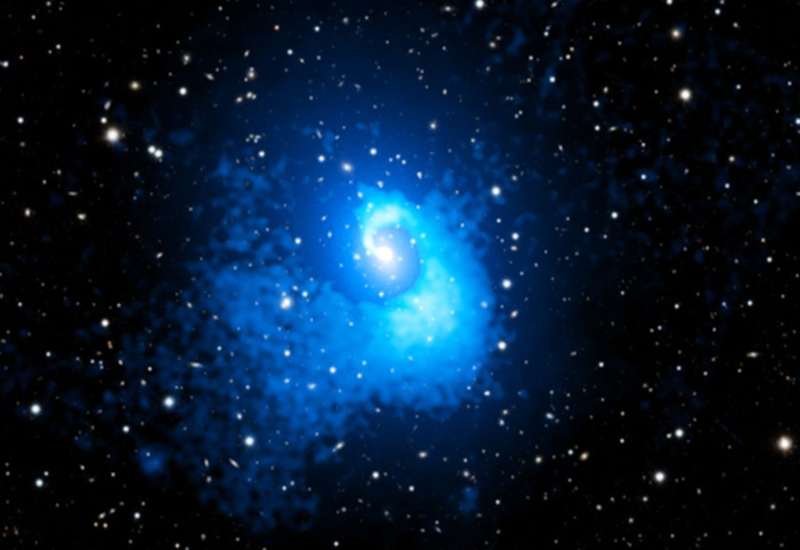
The Chandra Observatory found evidence of an ancient cosmic accident in what appeared to be the peaceful cluster Abell 2029.
Abell 2029: “Quiet” Cluster with Ancient Collision Signatures
The galaxy cluster Abell 2029 (in the constellation Virgo) has long been considered one of the quietest objects in the Universe. New X‑ray observations from the *Chandra* space observatory have shown that beneath this apparent calm there may be signs of an ancient collision.
What is Abell 2029?
- More than 1,000 galaxies are held together by gravity and surrounded by a vast cloud of hot gas (the “intergalactic medium”), which emits in the X‑ray band.
- At its center lies the giant elliptical galaxy IC 1101 – one of the largest known, with a diameter of almost 6 million light‑years.
- The cluster also contains a supermassive black hole (SMBH), whose activity influences the surrounding gas.
New data from *Chandra* and XRISM
1. XRISM studies in 2025
- Revealed extremely low turbulence in the gas, confirming the absence of major mergers in recent decades.
- However, one study found cooler regions within the hot atmosphere – a potential trace of ancient oscillations.
2. Boston University team (Courtney Watson)
- Used 21 *Chandra* observations (2022–2023) and archival data.
- After removing smooth X‑ray emission they uncovered hidden structures:
- A continuous spiral nearly 2 million light‑years long, formed by gas oscillations.
- A concave “bay” depression to the south of the core.
- A wide spike of cooler gas to the southeast.
- Possible shock waves at the cluster’s outskirts.
What do these structures mean?
- Models show they could have arisen after a smaller galaxy cluster passed through Abell 2029 about 4 million years ago.
- The collision displaced the hot gas; as a result it began to oscillate and rotate under the influence of the gravitational field.
- These motions help explain why the gas does not cool as quickly as expected: continuous energy loss via X‑ray emission.
The role of the black hole and ancient oscillations
- The SMBH in IC 1101 ejects energy, heating the surrounding gas.
- In Abell 2029 a single episode of SMBH activity may be insufficient to maintain the heat.
- Ancient gas oscillations also redistribute heat and slow cooling.
> “Overall our results indicate that A2029 is still coming into equilibrium after past interactions, showing that even the seemingly quietest clusters can hide a rich history of dynamic activity,” the researchers write.
Possible scenarios for forming the observed features
Scenario | What Happens
---|---
Crossing of a smaller cluster | The first part of the crossing stretches the gas, creating a giant spiral. Gravity slows and pulls the object back, generating shock fronts and new disturbances.
“Ghost bubble” from SMBH | The “bay” depression forms as the edge of a huge cavity created by the activity of the supermassive black hole in IC 1101.
Conclusion
The study published in December 2025 in *The Astrophysical Journal* demonstrates that even “quiet” galaxy clusters can retain traces of ancient collisions and dynamic processes that continue to influence their internal state millions of years later.
 Asted Cloud
Comments (0)
Share your thoughts — please be polite and stay on topic.
Log in to comment