
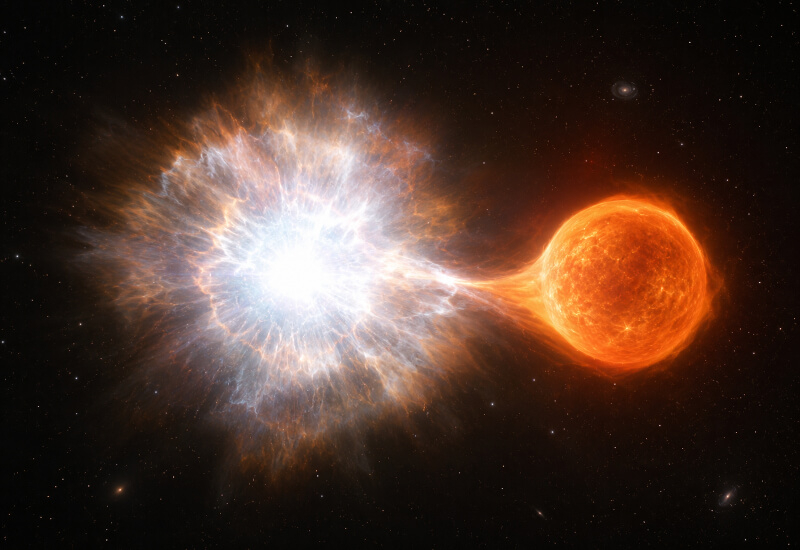
The explosions of white‑dwarf cannibals were heterogeneous, which over the years distorted the perception of dark energy
News in Own Words
Scientists from the University of Barcelona (UB) have introduced a new AI system called CIGaRS ("Combined Inference and Galaxy‑Related Standardisation"), which improves the accuracy of distance measurements to Type Ia supernovae and, as a result, enhances estimates of the Universe’s expansion rate. The results are published in *Nature Astronomy*.
What does CIGaRS do?
- It combines data on supernovae and their host galaxies into a single self‑consistent model.
- It works with observation streams coming from the Vera C. Rubin Observatory (LSST).
- Instead of traditional spectroscopic measurements, it uses photometric images and neural networks for analysis.
Thus the system more accurately determines:
1. The ages of stars that explode as Type Ia supernovae.
2. The metallicity (heavy‑element concentration) of those stars.
3. Distances to objects, which directly affect measurements of cosmic expansion.
Why is this important?
- Type Ia supernovae are considered “standard candles” because they have nearly the same critical mass of a white dwarf at which a thermonuclear explosion occurs. This allows their brightness to be used as a distance measure.
- In 1998, observations of supernovae led to the discovery of accelerated cosmic expansion and the concept of “dark energy,” accounting for ~68 % of its energy budget.
- However, in recent years it has become clear that supernova brightness slightly depends on the host galaxy environment: explosions in large/old galaxies differ from those occurring in young ones.
CIGaRS addresses this issue by modeling all key factors simultaneously (properties of host galaxies, interstellar dust effects, explosion rates, etc.) instead of sequential corrections. This increases distance measurement accuracy for tens of thousands of supernovae in a single pass.
How does this relate to future observations?
The Vera C. Rubin Observatory will conduct the Legacy Survey of Space and Time (LSST) – a decade‑long sky survey that images the accessible sky every few nights with a wide‑field reflector telescope. The CIGaRS system will be especially useful for processing the enormous volume of LSST photometric data and will be a key tool in refining parameters of cosmic expansion.
Key Quotes
> “A powerful way to model the Universe is to simulate it on a computer,” says Raul Jiménez.
>
> “This allows us to vary all parameters simultaneously to predict what kind of Universe we live in… The impact of such systematics on our conclusions is perhaps the most important missing ingredient in current approaches to cosmological modeling.”
Thus, the new AI platform CIGaRS paves the way for more precise cosmological measurements and helps better understand the nature of dark energy.
 Asted Cloud
Comments (0)
Share your thoughts — please be polite and stay on topic.
Log in to comment