
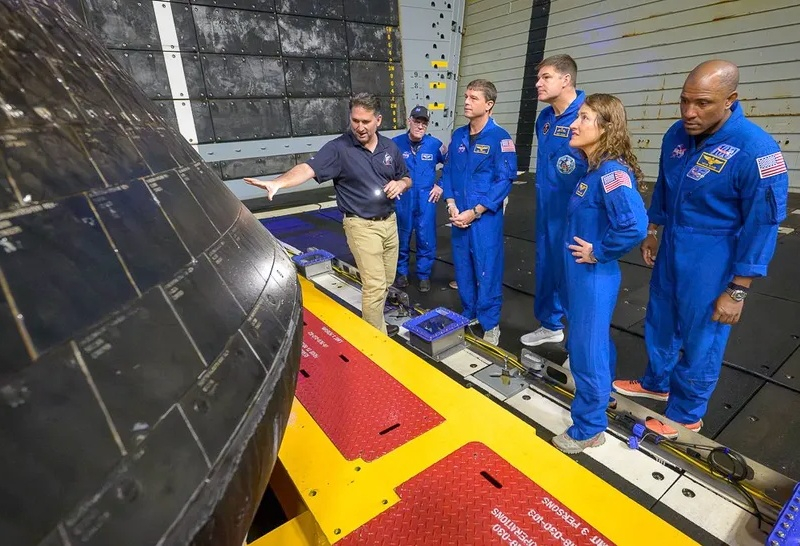
The heat shield screen glowed: the Artemis II astronauts inspected the capsule after returning to Earth
The “Integrity” heat shield – the key to a safe return of Orion
StageWhat happenedArtemis I (2022)A drone capsule Orion reached the Moon and returned to Earth. The 5‑meter‑wide heat shield sustained more damage than expected.Analysis by NASAAfter a detailed review, the decision was made to keep the same shield design for Artemis II but change the entry angle.Artemis II (2024)The capsule successfully passed high‑temperature testing; the “Integrity” shield – named by the crew – performed excellently.
Why it’s so important to test thermal protection
A spacecraft returns to Earth at speeds up to 11 km/s, and its outer shell can heat to 2800 °C. Therefore every component, especially the heat shield, is subjected to extreme loads.
What changed in Artemis II
1. The same shield design – NASA decided to keep the proven configuration.
2. New entry angle – the capsule entered the atmosphere at a steeper angle, reducing time spent in peak‑temperature zones.
3. Post‑landing check – the Artemis II team inspected the shield immediately after landing on 10 April.
Crew report
Mission commander Reed Wiseman (NASA) and astronauts Victor Glover, Christina Koch, and Canadian cosmonaut Jeremy Hansen conducted a visual inspection.
> “We noticed small scorch marks on the shoulder where the shield attaches to the spacecraft structure, but the lower section looked in excellent condition,” said Wiseman.
These observations are preliminary; NASA plans a more detailed analysis in the coming weeks.
What’s next
- Artemis III will remain in low Earth orbit to practice docking with the Orion capsule and lunar modules (SpaceX Starship, Blue Origin Blue Moon).
- Artemis IV will be the first mission where the capsule uses one of these modules to land near the Moon’s south pole and subsequently return to Earth. This test will impose even higher thermal protection requirements.
Thus, “Integrity” passed a critical test, confirming the reliability of the chosen design and paving the way for future lunar missions.
 Asted Cloud
Comments (0)
Share your thoughts — please be polite and stay on topic.
Log in to comment