
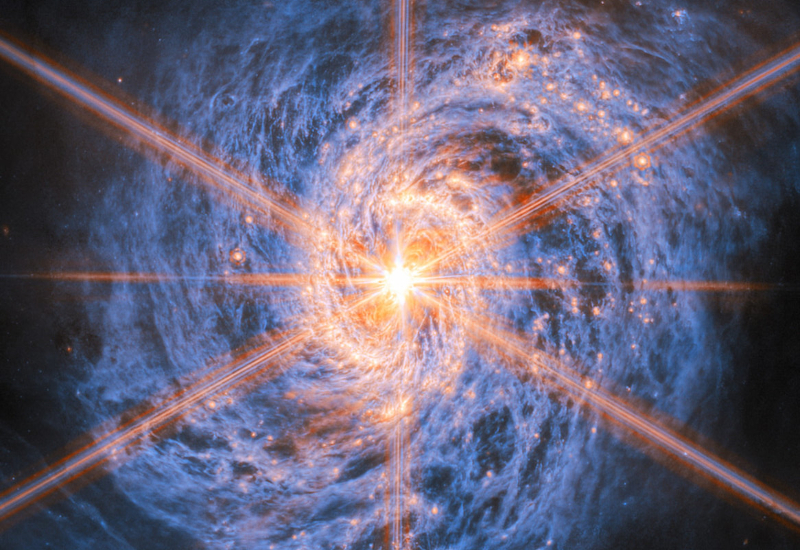
The James Webb telescope discovered the galaxy “Squid” with an astonishingly bright core in the constellation of China.
New image of Messier 77 from the James Webb telescope
NASA’s James Webb Space Telescope (JWST) has released a fresh infrared portrait of the spiral galaxy Messier 77, known as “The Squid.” The image was taken with the MIRI camera (Medium‑Resolution Infrared Camera) and earned the title “Image of the Month” thanks to its detail.
What we see in the image
Element Description
Spiral arms Brightly wound, almost like a classic spiral diagram.
Dust disk Warm (blue) emission from interstellar dust forming a swirling structure with cavities.
Active nucleus (AGN) A compact source of hot gas that outshines the entire galaxy and even “overloads” the cameras. It is powered by a supermassive black hole of about 8 M☉.
Orange lines Diffraction artifacts from the telescope’s mirror segments, unrelated to the galaxy.
Star formation and the central “bridge”
In the infrared range an invisible optical‑band bridge has been detected at the center of Messier 77. It is surrounded by a bright ring of star formation more than 6,000 light‑years in diameter, formed by the inner ends of two arms. Inside the ring are dense orange bubbles—flashes of new star birth. Because the galaxy is nearby (45 million light‑years), this ring has become one of the most studied examples of intense star formation.
Disk and outer arms
* Dust – thermal glow tinted blue, forming a swirling structure.
* Orange bubbles along the arms indicate recently formed stars.
* Beyond MIRI’s field of view are thin hydrogen filaments that form an extended ring thousands of light‑years wide. These filaments continue star formation and extend into intergalactic space, creating the galaxy’s outer envelope.
Why it matters
The image was obtained as part of program 3707 – *JWST Census of the Local Galaxy Population: Anchoring the Physics of the Matter Cycle*. The project aims to census massive nearby galaxies with active star formation. Thanks to JWST’s high resolution, individual stellar clusters and gas reservoirs can be distinguished, allowing detailed tracking of the birth, life, and death cycle of stars in Messier 77.
Thus, the new infrared portrait not only reveals the beauty of “The Squid” but also provides valuable information about star‑formation mechanisms and the active nucleus in our nearest galaxy.
 Asted Cloud
Comments (0)
Share your thoughts — please be polite and stay on topic.
Log in to comment