
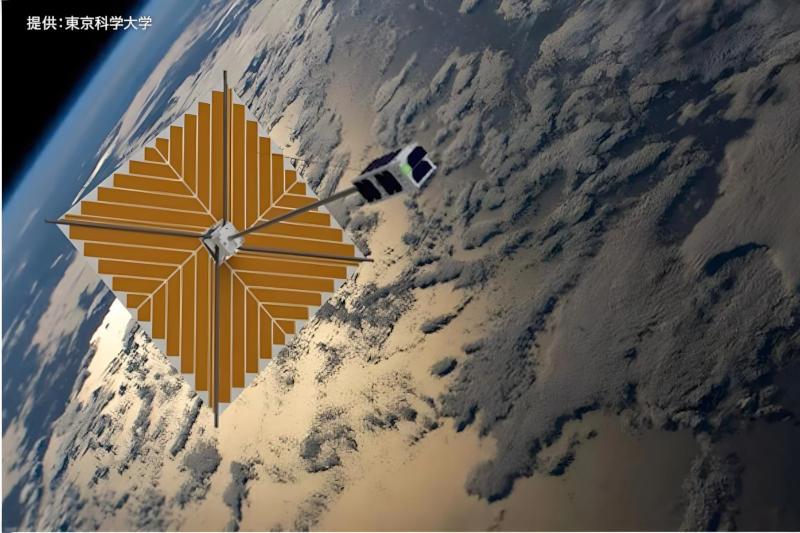
The Japanese satellite OrigamiSat‑2 successfully stabilized in orbit, increasing its area by 25 times.
Brief overview of the Kakushin Rising launch
On April 23, Japanese agency JAXA together with private contractor Rocket Lab launched the Kakushin Rising mission into orbit. The operation deployed eight small satellites designed for monitoring earthquakes, ocean conditions, and multispectral imaging.
How it happened
Stage | What occurred
Launch | Electron rocket lifted off from Rocket Lab’s launch site in New Zealand.
Time to orbit | Within about 53 minutes the satellites reached a sun‑synchronous orbit at an altitude of 540 km.
Orbital deployment | All eight small spacecraft were successfully positioned as intended.
What the satellites do
* Study earthquakes and their electromagnetic precursors
* Monitor ocean conditions (temperature changes, currents)
* Perform multispectral imaging with compact cameras
* Conduct additional scientific research tasks
Special focus on OrigamiSat‑2
- Dimensions: 10 × 10 × 34 cm (3U CubeSat format)
- Feature: a reflective phased array antenna that “unfolds” to a size 25 times larger than its original dimensions.
- Mission: demonstrate that a compact payload can be launched on a small rocket while still providing high antenna performance.
Unlike traditional parabolic mirrors, OrigamiSat‑2 creates a directed beam by controlling the phase of the reflected signal. Its lightweight design achieves high gain without complex mechanisms.
Conclusion: The Kakushin Rising mission successfully deployed eight small satellites into sun‑synchronous orbit, including an innovative compact CubeSat with a phased array antenna that opens new possibilities for space research.
 Asted Cloud
Comments (0)
Share your thoughts — please be polite and stay on topic.
Log in to comment